

Plan on $3,500 to $7,750 installed at a Canadian dealer for a pickup DPF, or $2,700 to $5,100 at an independent diesel shop with an aftermarket filter. The filter itself is the expensive part, and the Canadian dollar is why our bills run higher than the American ones. Before you approve a replacement, get the filter tested. A professional cleaning costs $350 to $650 in Ontario and fixes plenty of clogged filters that a dealer would rather replace.
- A dealer installed DPF in Canada runs $3,500 to $7,750, while an independent shop with an aftermarket filter runs $2,700 to $5,100, before tax.
- The L5P Duramax carries the highest dealer bill of the big three, and the 6.7 Cummins the lowest, with the 6.7 Powerstroke spanning the widest range.
- At $1.41 to the US dollar, every American part price lands about 40 percent higher here, before freight, duty, and tax.
- Professional cleaning in Ontario runs $350 to $650 and restores most intact filters, so test before you replace.
A DPF replacement on a Canadian diesel pickup runs $3,500 to $7,750 installed at a dealer, or $2,700 to $5,100 at an independent shop with an aftermarket filter, before tax. That is the number most owners actually see on the work order, and it is higher than the American figure for one simple reason. The parts are priced in US dollars, and at $1.41 to the American dollar, every part lands about 40 percent higher here before freight, duty, and tax.
I have watched owners read that estimate the same way for years. They stare at it, look at me, and ask if I typed an extra zero. I did not. A DPF is a precision ceramic brick sold as an assembly with the diesel oxidation catalyst, gaskets, and sensors, and the washcoat carries precious metals. But the quote is a starting point, not a verdict. Most clogged filters never needed replacing in the first place.
What does a DPF replacement cost in Canada by truck?
Here is the honest spread for the three engines in most Canadian driveways, converted from published American part prices at the November 2026 rate of $1.41, and checked against Canadian shop rates. These are installed totals, parts and labour, before tax.
| Truck | Dealer installed | Independent shop, aftermarket part |
|---|---|---|
| Ram 6.7L Cummins, 2013 to 2024 | $3,400 to $6,350 | $2,700 to $4,500 |
| Ford 6.7L Powerstroke, 2011 to 2024 | $3,650 to $8,450 | $2,800 to $4,950 |
| GM 6.6L Duramax L5P, 2017 to 2024 | $4,100 to $7,600 | $3,100 to $5,100 |
The L5P Duramax carries the highest dealer bill of the big three, because its filter assembly is the priciest part of the three. The 6.7 Cummins is the cheapest to replace, and the 6.7 Powerstroke spans the widest range. A 2011 to 2014 Powerstroke uses a simpler two canister layout and sits near the bottom of its range, while a 2020 and newer truck with the integrated DOC, DPF, and SCR assembly costs 15 to 25 percent more than the same truck a decade older.
Labour is the other half of the bill. Canadian independent shops charge $140 to $210 an hour in 2026, with Ontario and BC at the top of that range, and a dealer charges more again. The swap itself takes 3 to 5 hours on a clean truck, longer when rust or seized sensors fight you. That is why the same filter can cost $1,000 more at a Toronto dealer than at a shop in a smaller Alberta town.
Why is the Canadian bill higher than the American one?
Three things stack up, and none of them are the shop gouging you. First, the exchange rate. Almost every DPF sold in Canada starts life priced in US dollars, so a US$3,000 filter is $4,230 before it even crosses the border. Second, freight and duty. Filters are heavy, fragile, and shipped from American warehouses, and that cost sits in your quote. Third, tax. Every price in this article is before tax, and your invoice will not be. Ontario adds 13 percent HST, Alberta adds 5 percent GST, and the rest of the provinces sit in between. On a $5,000 job in Ontario, that is another $650. Ask for the out the door number, not the pre tax number, before you decide anything.
The ladder: four prices before you ever buy a filter
Most DPF problems get solved lower on this ladder than owners expect. Work up it in order, and stop at the first rung that fixes the truck.
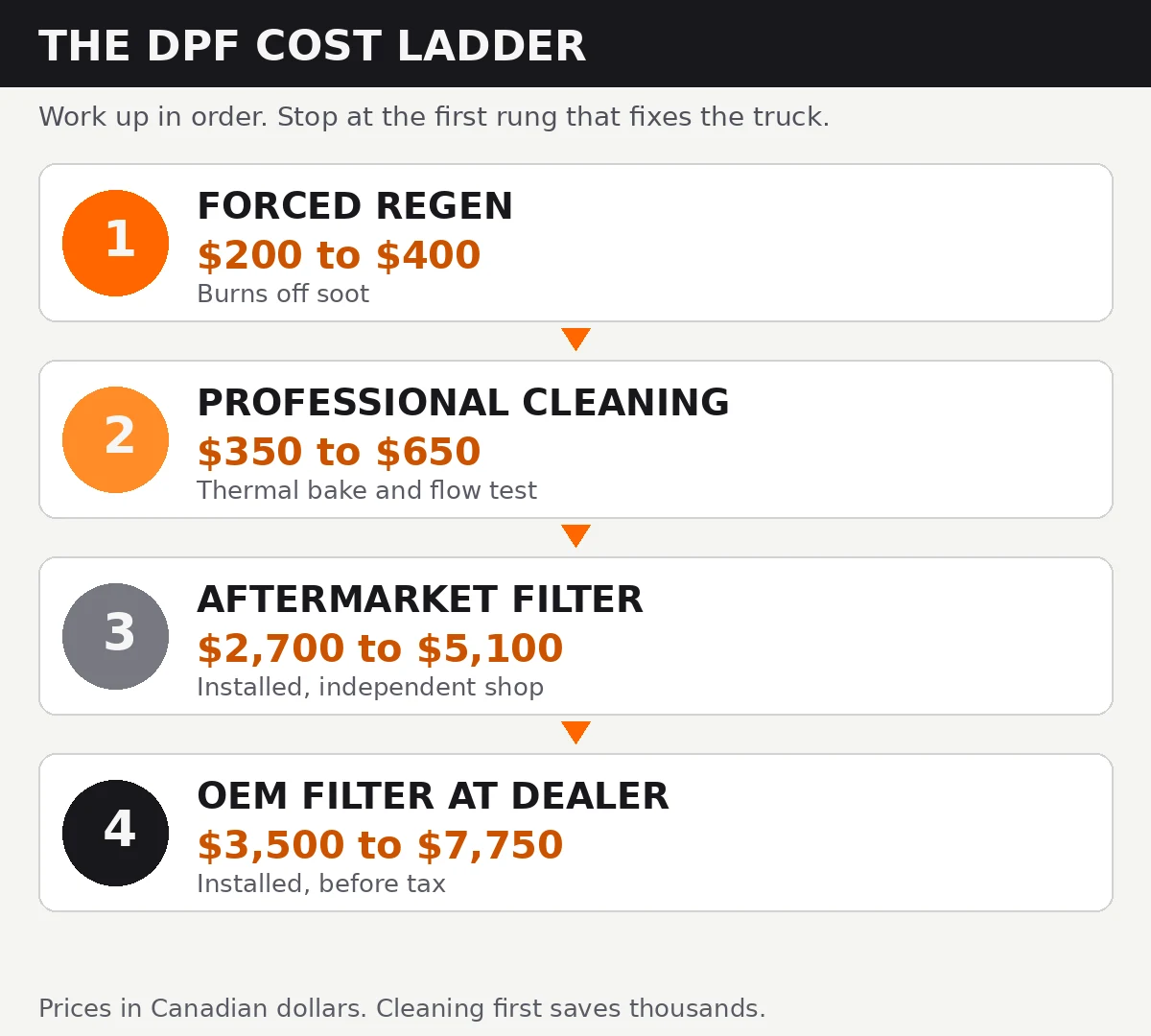
Rung one, forced regen, $200 to $400. This is for a filter loaded with soot that normal driving cannot clear. A shop triggers it with a scan tool. It burns off the soot and buys the filter more life, but it does not remove ash, and it does not fix whatever caused the clog.
Rung two, professional cleaning, $350 to $650 in Ontario. The filter comes off the truck and gets a proper thermal bake and flow test. A Mississauga shop publishes $350 to $500 for a DOC and DPF clean, and a Cornwall shop publishes $350 to $650 with flow testing. That is the real price for a pickup in Ontario, and it restores most intact filters. For heavy trucks, a mobile in frame clean in Edmonton runs about $1,275 per filter. My own guide to cleaning a DPF walks through which method fits which problem.
Rung three, aftermarket replacement, $2,700 to $5,100 installed. This is the right call when the brick is cracked, melted, or ash packed past recovery. A quality aftermarket unit costs 20 to 40 percent less than OEM and does the same job on a work truck. Buy from a brand your shop trusts, not the cheapest listing online.
Rung four, OEM replacement, $3,500 to $7,750 installed. This is the dealer route, and it is the right call on a newer truck, a warranty truck, or a truck you plan to sell. You pay for the factory part, the factory sensors, and a warranty on the work.
How do you read a DPF quote line by line?
A DPF quote is rarely one number. It is five or six lines, and the expensive surprises hide in the last three. Ask the shop to split it out.
The filter. This is the big line, $2,550 to $6,350 for the part alone in Canadian dollars. Check whether it is OEM or aftermarket, and whether the diesel oxidation catalyst comes with it or is a separate line. On 2020 and newer trucks the two often come as one assembly, and that is part of why the price jumped.
The labour. Expect 3 to 5 hours. If the quote shows 8 hours on a pickup, ask why. Rust and seized sensors are a fair reason on a ten year old truck in Ontario. A clean southern truck should not need it.
Sensors and hardware. This is the line that turns a $3,000 quote into a $4,500 invoice. Exhaust gas temperature sensors, the differential pressure sensor, gaskets, clamps, and mounting hardware add 30 to 50 percent on top of the filter price. Ask which sensors are included and which are extra, and ask to see the old ones. After a new filter, the truck also needs its soot counters reset and a regen relearn, so check that is on the quote too. A truck that never got its counters reset will throw codes on the drive home.
The tax. HST or GST on the whole job, on top of everything above. A $5,000 pre tax quote in Ontario is $5,650 out the door. Get that number in writing before you approve the work.
When is cleaning enough and when is the filter finished?
Cleaning works when the problem is soot and ash in an intact brick. It does not work when the brick itself is damaged, and no honest shop will sell you a clean on a filter that is cracked, melted, glazed with oil, or ash packed past its limit. Ask for three numbers before you approve anything: soot mass, differential pressure, and regen history. High soot mass with high differential pressure and a history of failed regens points at a filter that is done.
A leaking injector, a stuck EGR valve, or a failed turbo seal will clog a new filter just as fast as the old one, and replacing the filter without fixing the cause is the most expensive mistake in this whole article. That is also why a second opinion is worth the diagnostic fee. A $150 diagnostic that reads the data can save you $3,000, and any shop that refuses to show you the scan data before quoting a filter is a shop you should walk away from.
What pushes the bill up in Canada?
A few Canadian realities move the number, and they are worth knowing before the quote arrives.
Rust is the big one. A ten year old truck in Ontario or Quebec can have exhaust fasteners that will not move without heat and patience, and every seized sensor adds labour. A shop in Alberta sees cleaner fasteners and faster jobs, and the quote shows it.
Before you sign the work order
Five questions, asked in this order, will keep you from overpaying on a DPF job.
One, what do the scan numbers show, and can I see them? Two, is the filter cracked or melted, or just loaded with soot and ash? Three, what does a professional cleaning cost here, and what flow numbers do you guarantee after it? Four, is the quote OEM or aftermarket, and what is included in the parts line? Five, what is the out the door price with tax, and what is the warranty on the part and the labour?
If the shop answers all five cleanly, you are in good hands. If it cannot show you the data, cannot explain why cleaning will not work, or cannot split the quote, take the truck somewhere that can. A DPF is an expensive part, but it is not a mystery part. The numbers are all measurable, the options are all real, and the right answer is usually cheaper than the first price you hear.
Frequently asked questions
Should I replace my DPF or clean it first?
Clean it first, unless the ceramic brick is cracked, melted, or soaked in oil. A cleaning in Ontario runs $350 to $650, against $3,500 or more for a replacement, and it restores most intact filters to near full flow. Ask the shop for before and after differential pressure readings. If the pressure stays high after a proper thermal clean, the filter is finished and replacement is the honest call.
OEM or aftermarket DPF: which one should I buy?
Buy OEM if the truck is under warranty, if you tow heavy every day and need the filter to last another 200,000 kilometres, or if you plan to sell the truck soon and want no questions from the next buyer. Buy a quality aftermarket unit if the truck is older, out of warranty, and you are keeping it for work. Avoid the cheapest no name filters. A bad aftermarket DPF can crack, throw codes, and cost you the labour twice.
How long does a DPF last in Canada?
Most pickup DPFs last 200,000 to 300,000 kilometres before ash loading forces a decision, and plenty last longer on trucks that work on the highway. Short trips, long idling, and cold weather shorten that life, because the filter never gets hot enough to complete a regen. That is why a work truck that idles all winter in Fort McMurray can need attention far sooner than the same truck running highway miles in southern Ontario.
Does warranty cover a DPF replacement?
Emissions warranty in Canada generally covers the DPF for 8 years or 130,000 kilometres, whichever comes first, though the exact terms vary by manufacturer and model year. Check your warranty booklet before you pay anything, because a failed DPF on a truck inside that window should be a dealer warranty job, not your bill. A filter killed by oil contamination, bad fuel, or a neglected upstream fault is a harder claim, so keep your service records.